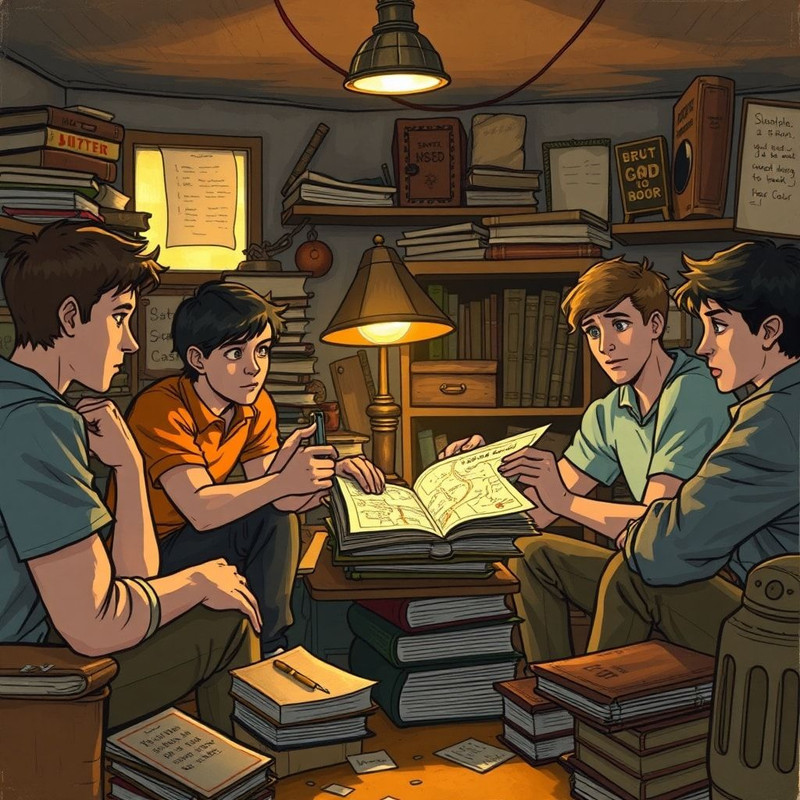
The Barking Oracle: How Five Teens, a Rogue Scientist, and a Genetically Awakened Dog Outsmarted the Impossible
The crate’s whimper wasn’t a whine. It was a word—low, deliberate, shaped by something that shouldn’t exist. Chloe’s fingers stilled around the tarnished silver spoon she’d been cataloging. The antique shop’s back room smelled of lemon oil and old secrets, but this sound was new. Wrong. Human.

At DotNXT let's Unfold the story of Buster, the golden retriever who spoke in baritone, solved crimes with his nose, and became the most dangerous secret in Willow Creek.
---
The Night the Lab Spoke Back
Mrs. Gable’s science lab was a relic of 1970s pedagogy: Bunsen burners with frayed cords, a skeleton missing three ribs, and the perpetual scent of burnt popcorn from the microwave in the corner. The air hummed with the quiet static of fluorescent lights, the kind that made your teeth ache if you listened too long. Chloe had spent the last twenty minutes inventorying the shop’s stolen silver, her pen scratching against graph paper in precise, looping script. Leo was muttering about Wi-Fi dead zones, his fingers flying over a laptop balanced on a stack of old encyclopedias. Maya sat cross-legged on the floor, her sketchbook open to a half-finished portrait of a moth, its wings rendered in delicate, smudged charcoal. Sam, ever the kinetic force, was attempting to teach Buster to high-five, his laughter echoing off the linoleum.
Then the crate whimpered.
"Let… me… out."
The words slithered into the silence like a blade. Sam’s hand froze mid-air. Leo’s screen went dark, his breath hitching. Maya’s pencil snapped between her fingers. Chloe didn’t turn around. She didn’t need to. The voice had come from the therapy dog—the one Mrs. Gable had dropped off with a breezy, "He’s great for anxiety!"
Buster shifted in the crate, his golden fur pressing against the metal slats. His brown eyes, usually soft with canine patience, were sharp. Focused. Aware. "It’s stuffy in here," he said, his voice a clear, almost theatrical baritone. "And the acoustics are appalling. Do you humans not value sound quality?"
Leo’s mouth opened. Closed. Opened again. "Did—did the dog just—"
"Yes, Leo," Buster sighed. "And no, I am not a ventriloquist’s dummy. Though I suppose that would be a more palatable explanation for your fragile sensibilities."
Chloe finally turned. The crate was small, too small for a dog of Buster’s size, but he didn’t seem to mind. He stretched, his paws pressing against the door, and the latch clicked open with a sound like a gunshot. He stepped out, shook himself, and fixed them each with a look that was equal parts amusement and pity. "Well? Are we going to stand here all evening, or shall we address the elephant in the room? Or, in this case, the dog."
Maya was the first to move. She crawled forward, her sketchbook forgotten, and reached out a trembling hand. Buster sniffed her fingers, then licked them. "You taste like charcoal and lavender soap," he said. "An interesting combination."
Sam, ever the optimist, grinned. "Dude. You’re talking."
"Astute observation," Buster replied dryly. "Now, if you’re quite finished with the existential crisis, I believe there’s a bowl of kibble with my name on it."
And just like that, the world tilted. The air in the lab wasn’t just thick with the scent of formaldehyde and old textbooks anymore. It crackled with something else—something electric, something alive. The Curiosity Club, a ragtag group of kids who asked too many questions, had just become the custodians of the impossible.
---
The Salt of Old Regrets
The first case wasn’t a murder. It wasn’t even a theft, not really. It was garden gnomes.
Mrs. Henderson, Chloe’s next-door neighbor, was a woman of precise habits. Her lawn was a chessboard of manicured squares, her rose bushes pruned to within an inch of their lives. Every morning at 7:13 AM, she watered her petunias with a watering can shaped like a smiling frog. Every evening at 6:47 PM, she adjusted the ceramic gnome in the center of her garden—the one holding a fishing rod, its red hat chipped from years of weathering—by exactly three degrees to the left.
But the gnomes were disappearing.
One by one, they vanished. The fisherman. The accordion player. The gnome with the suspiciously knowing grin. The adults blamed squirrels. Teenagers. A particularly ambitious raccoon. Mrs. Henderson, however, was convinced it was something darker. "They’re being taken," she whispered to Chloe one afternoon, her hands shaking around a cup of lukewarm tea. "I can feel it. Like someone’s watching."
Chloe, ever the pragmatist, had nodded and promised to look into it. But it was Buster who took the case seriously.
"Garden gnomes," he grumbled, sprawled across Chloe’s bedroom rug like a disgruntled lion. "How utterly beneath my intellectual capacity."
Sam, perched on the edge of Chloe’s bed, leaned forward. "Come on, Buster. It’s practice. Low stakes. High reward."
Buster sighed, a deep, rumbling sound that vibrated the floorboards. "Very well. But if I solve this, I expect a steak. A real one. Not that kibble nonsense."
The next evening, they descended upon Mrs. Henderson’s garden. The air was thick with the scent of damp earth and the faint, acrid tang of the compost heap behind her shed. Leo’s drone buzzed overhead, its camera scanning for footprints or disturbed soil. Maya crouched near the flowerbeds, her fingers tracing the outlines of the remaining gnomes. Sam, ever the diplomat, was attempting to interview Mrs. Henderson about her recent visitors, though she kept getting sidetracked by stories of her late husband’s prize-winning dahlias.
Buster, however, was focused on the azaleas.
He sniffed around the base of the bushes, his tail wagging in slow, deliberate arcs. "Hmm," he murmured. "Freshly turned soil. And something else… metallic. Almost like…"
His nose nudged a loose paving stone. Beneath it, half-buried in the damp earth, was a silver button. Not just any button—a tiny, tarnished thing, the kind used on old-fashioned gardening gloves.
Chloe picked it up, her fingers brushing against the cold metal. "This isn’t from Mrs. Henderson’s things."
Buster’s ears perked. "No. It’s from someone who didn’t want to be seen."
The button was their first clue. Their first lead. And it was Buster, the dog who had once scoffed at the case, who had found it.
---
The Man Who Collected Lost Things
The button led them to Barty Jenkins.
Barty lived three blocks over in a house that smelled of mothballs and regret. The walls were lined with shelves, each one crammed with "found objects": a single earring, a child’s mitten, a chipped teacup with a faded floral pattern. He was a hoarder, but not the kind you saw on TV. There was no filth, no chaos. Just… things. Lost things. Things no one else wanted.
"I don’t steal," he said when they confronted him, his voice trembling. "I rescue."
Chloe held up the button. "This was under Mrs. Henderson’s azaleas."
Barty’s eyes flickered to the silver disc, then away. "I don’t know what you’re talking about."
Buster, sitting at Chloe’s feet like a well-trained (if unusually large) dog, let out a low growl. "Liar."
Barty flinched. "I—I didn’t mean any harm! The gnomes were just… sitting there. Unloved. Unappreciated."
Leo, who had been quietly filming the exchange on his phone, cleared his throat. "So you did take them."
Barty’s shoulders slumped. "I was going to return them. Eventually."
The gnomes were recovered that same afternoon, each one carefully wrapped in newspaper and tucked into a cardboard box. Mrs. Henderson cried when she saw them, her hands shaking as she adjusted the fisherman’s hat just so. The police, initially skeptical of the "kids with the talking dog," couldn’t argue with the evidence. Barty confessed. The case was closed.
But something had shifted.
Word spread. Not about Buster—not yet—but about the "weird kids who actually find things." Captain Davies, the town’s grizzled police chief, started leaving messages on Chloe’s voicemail. Not official requests. Not yet. Just… questions. Casual inquiries. "Heard you helped Mrs. Henderson out. You know, we’ve got a few… unsolved cases. Cold ones."
Chloe deleted the messages. But she didn’t forget them.
---
The Candy Aisle Conundrum
The convenience store thefts started small.
First, it was just the candy. The good stuff—chocolate bars, gummy worms, the kind of treats that made your teeth ache just looking at them. The thief would strike at odd hours: 2:17 AM, 4:43 PM, 11:02 on a Tuesday. They never took anything else. Just the candy. And they never got caught.
Then the hoses disappeared.
Not all of them. Just the long, expensive ones—the ones with the brass fittings, the ones that coiled like snakes in the hardware store’s garden section. The thief would strike at night, cutting through the plastic ties that bound the hoses to the shelves, leaving behind a trail of damp footprints and a single, infuriating question: Why?
The police were baffled. The town was amused. The kids of Willow Creek, however, were intrigued.
"It’s the same person," Leo said one evening, his laptop balanced on his knees. They were gathered in the science lab, the air thick with the scent of stale pizza and Buster’s kibble. "The candy thief and the hose thief. Same MO. Same… vibe."
Buster, sprawled across the floor, let out a snort. "The vibe is desperation. And bad life choices."
Sam, ever the optimist, grinned. "So we’re saying it’s a criminal mastermind?"
"I’m saying it’s someone who’s hungry," Buster replied. "And possibly in need of a hobby."
The next night, they staked out the convenience store. Leo’s drone hovered overhead, its camera trained on the candy aisle. Maya sketched the scene in her notebook, her pencil moving in quick, sure strokes. Sam, armed with a walkie-talkie and a bag of beef jerky ("for morale"), kept watch from the parking lot. Chloe and Buster, meanwhile, hid behind a display of motor oil, their breath shallow, their eyes fixed on the flickering fluorescent lights.
At 2:17 AM, the thief struck.
They moved like a shadow—quick, silent, almost liquid. One moment the candy aisle was empty. The next, a figure in a dark hoodie was stuffing chocolate bars into a backpack. They didn’t run. They didn’t panic. They just… took. And then they were gone, slipping out the back door like smoke.
Buster’s nose twitched. "Synthetic fibers," he murmured. "Cheap aftershave. And… ferrets."
Chloe blinked. "Ferrets?"
"The thief has ferrets," Buster confirmed. "Or at least, they’ve been in close proximity to them recently."
Leo’s drone footage confirmed it: the thief had left behind a single, unmistakable clue—a tiny, muddy paw print on the linoleum, too small to be a cat’s, too large to be a mouse’s.
The case of the candy aisle conundrum was solved the next day. The thief was a seventeen-year-old named Jamie, who lived in a trailer park on the edge of town with his mom, his little sister, and three ferrets named Larry, Curly, and Moe. He’d been stealing the candy to sell for cash, the hoses to water his mom’s garden. He wasn’t a criminal mastermind. He was just a kid, trying to keep his family afloat.
Captain Davies, when he heard the story, didn’t laugh. He didn’t scoff. He just nodded, his eyes flickering to Buster for the briefest of moments before he turned away.
---
The Night the Heiress Didn’t Come Home
Eleanor Vance was supposed to be untouchable.
She lived in a mansion on the hill, its windows glowing like fireflies in the dark. She drove a car that cost more than most people’s houses. She wore jewelry that sparkled even in the dimmest light. And she was dead.
Her body had been found by the old mill pond, her silk blouse stained with mud, her fingers curled into the damp earth like she’d been trying to claw her way out. The police called it a robbery gone wrong. But Eleanor’s jewelry was still on her body. Her wallet was still in her purse. And her security system, one of the most advanced in the state, had shown no signs of forced entry.
Captain Davies called Chloe at 3:14 AM.
"We’ve got a situation," he said, his voice gruff. "And I think… well. I think you might be able to help."
The crime scene was a nightmare of flashing lights and hushed voices. The air smelled of wet leaves and something darker—something metallic, something wrong. Buster, usually so unflappable, pressed close to Chloe’s side, his ears flat against his head.
"The scent of fear is potent here," he murmured, his voice barely above a whisper. "And something else… floral. Almost like…"
"Lavender," Maya said, her eyes fixed on the muddy bank. "I smell it too."
Leo was already pulling up Eleanor’s financial records on his tablet, his fingers flying over the screen. Sam, pale but determined, was talking to one of the officers, his voice steady despite the tremor in his hands. Chloe, meanwhile, knelt beside the pond, her fingers brushing against the disturbed earth near the water’s edge.
Buster’s nose twitched. "There," he said, nudging a small indentation in the mud. "A heel mark. Small. And the soil here… it suggests a struggle. A dragging motion."
Chloe’s breath caught. "She wasn’t killed here. She was moved."
The lavender scent was the key. It led them to a niche perfumery twenty miles away, to a specific blend of lavender and patchouli that only three people in Willow Creek had purchased in the last six months: Eleanor Vance herself, her estranged niece Bethany, and her longtime gardener, Marcus Thorne.
Bethany had an alibi. Marcus did not.
---
The Gardener’s Gloves and the Scent of Guilt
Marcus Thorne lived in a cottage on the edge of Eleanor’s estate. The air around it was thick with the scent of damp earth and fresh-cut grass, the kind of smell that clung to your clothes long after you left. The garden was immaculate—rows of roses, their petals dewy with morning mist, a vegetable patch bursting with tomatoes and zucchini, a small herb garden where lavender grew in neat, fragrant rows.
Buster’s nose led them straight to the potting shed.
The gloves were old, worn, the leather cracked with age. But they weren’t just dirty. They were stained. Not with soil, not with fertilizer, but with something darker. Something that smelled, as Buster put it, like "old blood in a refined mixture."
Marcus, when confronted, didn’t deny it. He didn’t even try.
"She was going to cut me out," he said, his voice hollow. "Twenty years I worked for that woman. Twenty years. And she was just going to… let me go. Like I was nothing."
Bethany’s alibi, it turned out, was a lie. She’d been at the charity gala, yes—but she’d left early, her coat (drenched in the same lavender perfume) "accidentally" left at Marcus’s cottage. The plan was simple: Marcus would do the dirty work. Bethany would inherit. And no one would ever know.
Except they hadn’t counted on Buster.
---
The Ghost of Willow Creek
The Willow Creek Disappearance was a wound that had never healed.
Clara Henderson—no relation to Mrs. Henderson, though the coincidence wasn’t lost on anyone—had vanished in 1998. She was sixteen, bright-eyed, full of dreams. She’d gone to a high school dance and never come home. Her car was found abandoned near Willow Creek, the driver’s side door open, the keys still in the ignition. No body. No witnesses. No answers.
Twenty-five years later, the case was still open. Still cold.
Until Buster.
The archives room smelled of old paper and forgotten hope. The files were brittle, the ink faded, the edges of the photographs curled with age. Buster, his head resting on Chloe’s lap, let out a low, mournful sigh. "The weight of twenty-five years," he murmured. "It’s a dense accumulation of regret."
Leo was running the photos through forensic software, his screen glowing with grainy, enhanced images. Maya was sketching a timeline, her pencil moving in quick, angry strokes. Sam was interviewing Clara’s classmates, his voice gentle, his questions careful. Chloe, meanwhile, was sifting through the files, her fingers stained with the grime of history.
Buster needed scent.
They convinced Captain Davies to let them into Clara’s childhood bedroom. The room was a time capsule: a teddy bear with one eye missing, a poster of NSYNC on the wall, a diary locked in a desk drawer. The air smelled of mothballs and dried potpourri, but beneath it, Buster found something else—something Clara*. Lavender soap. Strawberry shampoo. And beneath that, the faint, bitter tang of fear.
"Nervous energy," Buster said, his voice soft. "She was afraid."
The last known location was Willow Creek, a place where the air was perpetually damp, where the trees whispered secrets to the wind. Buster spent hours there, his nose to the ground, his tail still. He kept returning to a spot near an old willow tree, its roots gnarled and twisted, its branches heavy with moss.
"Here," he said finally, nudging a small, corroded button with his nose. "The scent is faint, but it’s there. Medicinal. Like old iodine. And pine needles."
The button was the kind used on hospital uniforms.
---
The Nurse Who Knew Too Much
Martha Jenkins was a woman of routine.
She woke at 5:30 AM. She drank her coffee black. She watered her plants at precisely 6:15. She never deviated. Never changed. Never stopped.
She had worked at the local clinic in 1998. She had lived near Willow Creek. And she had a secret.
"I didn’t mean to," she whispered, her hands shaking around a cup of tea that had long gone cold. "She saw me. She saw me burying the supplies. I panicked. I just… I just pushed her. And then she was gone."
Clara hadn’t been murdered. Not intentionally. She’d drowned in the creek, her body carried downstream by the current, lost to the river’s endless hunger. Martha had spent twenty-five years living with the guilt, with the fear, with the knowledge that she had taken a life.
The confession brought closure. But it also brought something else: attention.
---
The Lab’s Long Shadow
The phone call came on a Tuesday.
Chloe was in the middle of a chemistry experiment (badly, since Mrs. Gable had confiscated all the good equipment after the "incident" with the baking soda volcano) when her phone buzzed. The number was blocked. The voice on the other end was clipped, precise, cold.
"This is Dr. Evelyn Reed," the woman said. "We’ve been monitoring Buster’s… unique capabilities. His advanced cognitive functions and linguistic abilities are… anomalous. We need to assess his stability. For his safety, and for others."
The line went dead.
Chloe’s hands shook. The taste in her mouth was metallic, sharp. Fear.
Buster, who had been dozing by the window, lifted his head. His ears twitched. "They’re coming," he said, his voice barely above a whisper. "I can smell them."
---
The Scent of Peppermint and Desperation
The case of the stolen pension money was small. Insignificant, really. A scam. A phishing operation targeting the elderly. But it was theirs.
The air in the lab was thick with the scent of rain and old books, the usual hum of activity replaced by a quiet, desperate focus. Leo was tracing digital footprints, his screen glowing with lines of code. Maya was sketching out a map of the town, her pencil moving in quick, sure strokes. Sam was on the phone with Mr. Abernathy, his voice low, his questions careful. Chloe, meanwhile, was cross-referencing call times with scent signatures, her fingers flying over her keyboard.
Buster, who had been dozing by the fireplace, suddenly lifted his head. "Peppermint," he murmured. "And cheap aftershave. And… desperation. The sharp kind. The kind that cuts."
Maya’s head snapped up. "Peppermint! Mr. Abernathy always carries peppermint candies. He said something felt off about the caller."
The pieces clicked into place. The scam wasn’t random. It was targeted. And the thief was closer than they thought.
---
The Barn at the Edge of the World
Dr. Eleanor Finch was a ghost story.
She had vanished from the scientific community years ago, after publicly denouncing "unethical animal experimentation." No one knew where she’d gone. No one knew what she’d been working on. No one, that is, except Buster.
"She was… different," he said one evening, his voice soft. "She believed in healing. Not control."
The barn was exactly where he said it would be: on the outskirts of town, hidden behind a wall of overgrown trees, its weathered wood silvered with age. The air smelled of damp earth and old hay, of secrets buried deep. Dr. Finch met them at the threshold, her silver hair pulled back in a loose bun, her eyes sharp, her smile warm.
"I’ve been expecting you," she said, her voice like honey. "Come in. Before they see."
The hidden basement was a marvel of quiet resistance. Shelves lined with equipment, walls covered in schematics, a small, insulated room humming with the quiet pulse of machinery. Dr. Finch had been preparing for this day for years.
"They’ll come for him," she said, her voice steady. "But we’ll be ready."
---
The Black Sedan and the Ultimatum
The signs were subtle at first.
A black sedan parked outside Chloe’s house. A crackle on Sam’s walkie-talkie. A probe in Leo’s firewall, too precise to be random.
Then the email arrived.
It was short. Encrypted. Untraceable. A single image: Buster, playing fetch in Chloe’s backyard, captured through a telephoto lens. And a message: "Retrieve Subject 734. Immediate compliance or alternative measures will be deployed."
The air in the lab was thick with the scent of ozone, of fear, of them.
Buster’s ears flattened. "They’re close," he growled. "Too close."
---
The Midnight Run
They moved under the cover of darkness.
The air was thick with the scent of damp earth and distant woodsmoke, the usual sounds of the town muffled by the fog. Leo’s drone buzzed overhead, its camera scanning for movement. Maya’s sketchbook was tucked into her backpack, her pencil ready. Sam’s walkie-talkie crackled softly, a lifeline to the world they were leaving behind. Chloe’s fingers were tight around Buster’s leash, her heart pounding in her chest.
The barn loomed ahead, its silhouette ghostly in the mist. Dr. Finch was waiting, her face a mask of quiet determination. "Hurry," she said. "They’re already here."
The hidden basement was their sanctuary. Their hope.
But the fight was far from over.
---
Echoes & Questions
- What if the next Buster isn’t a dog? What if it’s a bird? A cat? A child? - How many other "Subject 734s" are out there, hiding in plain sight? - Can a secret this big ever truly be safe? - What happens when the hunters become the hunted? - Is justice still justice if it’s delivered by a talking dog? - How do you fight an enemy you can’t see, can’t touch, can’t smell?
---
Moments That Stay With You
- The first time Buster spoke, and the world shifted on its axis. - The silver button in the azalea bush, glinting like a promise. - Barty Jenkins’s confession, his hands shaking around a cup of tea. - The scent of lavender at the mill pond, thick with the weight of a life taken. - Martha Jenkins’s tears, twenty-five years too late. - The black sedan outside Chloe’s house, its windows dark, its presence wrong. - Dr. Finch’s smile, warm and fierce, as she welcomed them into the barn.
---

Conclusion
The barn smelled of dry straw and old electronics, of hope and quiet resistance. The teens—Chloe, Leo, Maya, Sam—had started as a group of kids solving petty thefts and garden gnome mysteries. Now, they were something else. Something more. They were a family. A team. The guardians of a secret that could change the world.
Buster, the golden retriever with the baritone voice and the nose for trouble, had given them more than just answers. He had given them a purpose. A fight. A future.
The Lab was still out there. The hunt wasn’t over. But for the first time, they weren’t running. They were ready.
What secrets are hiding in your own backyard? What extraordinary stories are waiting to be uncovered? Sometimes, all it takes is a keen eye, an open mind, and the courage to listen—even when the voice you hear belongs to a dog. Start your own investigation today.

No comments:
Post a Comment
Any productive or constructive comment or criticism is very much welcome. Please try to give a little time if you can fix the information provided in the blog post.